More about the workshop:
All levels of ability and experience are welcomed to the session. We are excited to gather everyone together for this fantastic experience with two of the most knowledgable people from the Maracatu community as they make their way around Europe for their 2025 tour.
In the workshop, the tutors will guide us through percussion patterns for a range of instruments, and will invite us to sing along several simple songs straight from the Maracatu tradition (voice and drums work together always in this way).
Instrumentation:
Alfaias (rope tuned bass drums), caixas (snare drums), gongue/agogo bell, agbê/shekere, mineiro/ganzá, voice.
All instruments can be provided by Juba do Leão and Global Grooves. If you do have any of the above, please do bring them along (including sticks and straps).
What is Maracatu?
The state of Pernambuco in Northeast Brazil is a highly rich melting pot of Carnival cultures, music, and tradition. One of these native traditions of Pernambuco is that of the Maracatu Nação. The intoxicating and powerful style of Maracatu Nação (Nation) is also known as Baque Virado [turned beat]. The name ‘Nação’ reflects the African heritage of the tradition. This strand of Maracatu sets its origins in a time where people (including prominent community figures) were brought from Africa to a life of oppression as enslaved people in Brazil. To maintain their native rituals and beliefs, as well as honour the struggles and offer solidarity to one another, a member of the community would be crowned as a ‘Rei do Congo’ [King of Congo] at a coronation ceremony organised by the enslaved people featuring music, song, and dance. Maracatu has links to Afro-Brazilian religions such as Candomblé, Jurema, and Macumba, and often these traditional Nação groups are based in a terreiro (where sacred religious rituals are practised). The principles of these religions combine with the Maracatu crowning practices. When slavery was abolished in 1888, these Kings of Congo ceased to exist in the same way, but the Nação groups of Pernambuco continue to preserve and promote the traditions of the Maracatu ceremony until the present day. READ MORE
About the tutors
Mestre Toinho
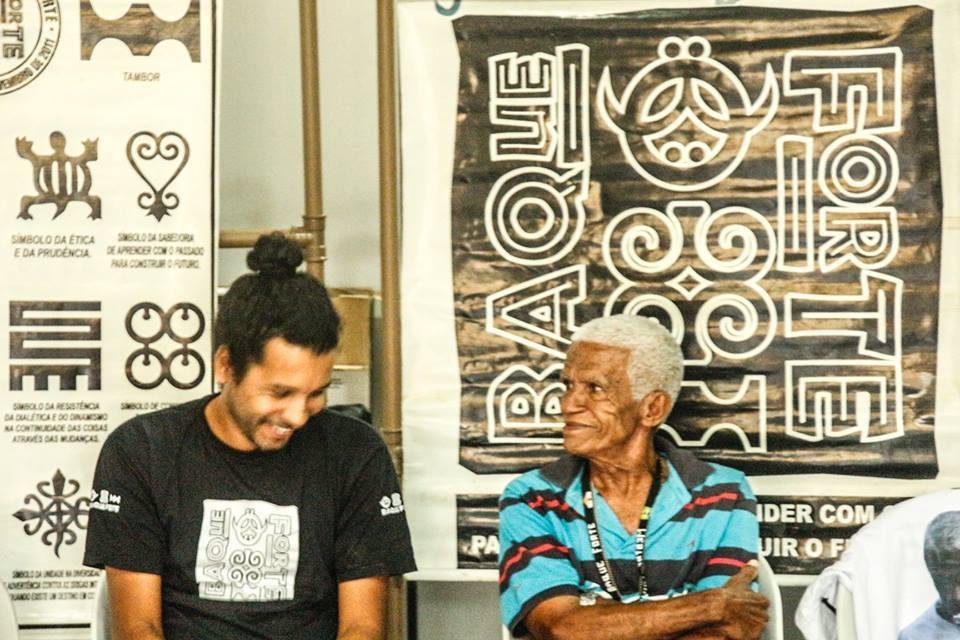
Antônio Pereira de Souza, known as Mestre Toinho, is the oldest living Maracatu Nação Mestre. He is currently the oldest active maracatuzeiro, possesses the greatest living repertoire of toadas (songs) of Maracatu Nação, besides being one of the only ones to perform the same style of baque (type of Maracatu beat) used by Mestre Luiz de França, heir to the knowledge and batuques of Leão Coroado, with whom he had a long experience. He has participated in Maracatu since he was young, counting more than 50 years of performance in the Maracatus. He met Dona Santa, the renowned queen of Maracatu Elefante, who died in 1962.
He was part of the former Maracatu Nação Cambinda Estrela, also worked in Maracatu Indiano, Maracatu Estrela Brilhante, Centro Grande Leão Coroado, Elefante, Maracatu Encanto da Alegria, and currently, is part of the Maracatu Nação Baque Forte. Mestre Toinho’s approach has a particular style, drawing on the course of his experience of batuque. The drummers who have, or have had, the chance to learn with Mestre Toinho, unanimously affirm that to play with him is to be in touch with what is most traditional in the culture of Baque Virado.
Mestre Jamesson Florentino
Mestre Jamesson Florentino is teacher, craftsman and articulator of Maracatu Nação Baque Forte. A Maracatuzeiro from his youth, he acted as batuqueiro of Maracatu Nação de Luanda, Mestre Roberto, Maracatu Cabeça de Nêgo, Mestre Maureliano Barravento, and Maracatu Nação Cambinda Estrela. He was Mestre of Maracatu Leão da Campina and performs activities as a craftsman in the making of drums and other Maracatu instruments and in the production of skins and accessories.
One of the founders of the Maracatu Nação Baque Forte, he develops works related to education, culture and professional formation within the young Nação group, founded in 2011, with the intention of maintaining what is more traditional through the knowledge acquired with the Maracatus of the past and in coexistence with the Mestre Toinho. The union of Mestre Toinho’s vast experiences and knowledge with the active work of enriching the everyday community, imbued with the underlying meanings the practice of Maracatu as an activity of resistance by Mestre Jamesson, results in a rich meeting of both modern and timeless ways of making the Maracatu de Baque Virado.
We are so pleased they could join us here in Manchester again to give us this very special gift.
Time:
7pm – 10pm (arrive from 6:45pm)
Venue:
The Vale (theatre space), Unit 2 Vale Mill, Micklehurst Road, Mossley, Ashton-under-Lyne, OL5 9JL
Access:
If you have any access requirements to be able to attend, please complete the form at the base of this page, or let us know via email or phone ([email protected] / 01618706895).
About Juba do Leão:
JDL are a percussion and dance collective specialising in blasting out the roots beats and moves from the streets of Pernambuco, Brazil. The group have built partnerships within the cultural communities of Northeastern Brazil, and are excited to receive Mestre Toinho and Mestre Jamesson to continue to deepen their international friendship and cultural exchange.
www.jubadoleao.com